When 94% Stares Back at You
On fear, the brain, and the CPA who chooses to become something new

Some of you read my previous post, the one about losing my purse in Denver, and what I learned about fear and creating possibility somewhere between a rental car counter and a moment of unexpected grace.
I’ve been sitting with that story ever since. I’ve told it a few times and in the telling re-experienced the miracles of support and help I received from so many strangers along the way. Diving into the story from time to time to uncover the nuggets therein to live a more prosperous, joy filled life.
Fast forward two months, I am at my desk, deep in preparation for a talk I’ll be giving at the AICPA’s Engage conference, the largest gathering of CPAs in the country every year. My session is on neuroscience: specifically, understanding how the brain works so CPAs can craft services in a way that transforms a client’s relationship to money from one encased in fear or avoidance to one of abundance and joy.
I was building my research file. Reading papers. And then I opened a study published on March 5th by Anthropic, the AI safety company behind Claude, titled “Labor Market Impact of AI: A New Measure and Early Evidence.”
I got to page six.
And I stopped.
One number. Right there on the page.
94.3%.
That is the theoretical capacity of AI to cover the tasks in business and finance occupations. Not someday. Not in a speculative future. Theoretically, right now.
I sat with that for a long time.
Because I know who reads these letters. And I know what that number probably just did to your nervous system.
What Your Brain Just Did With That Number
Here’s what neuroscience tells us happens in the milliseconds after you read something like that.
Your amygdala, the brain’s threat detection center, the ancient alarm system we share with every mammal that has ever run from a predator, fires first. Before your prefrontal cortex (the part that reasons, strategizes, and imagines the future) even gets the signal, your body is already in response mode.
Heart rate up. Shoulders tight. A quiet, low-grade hum of “Is this the end?”
This is not weakness. This is biology. Your brain is doing exactly what it was designed to do: protect you from threat. The problem is, your amygdala cannot distinguish between a lion and a statistic. It responds to both the same way.
And so here is what many CPAs will do with that 94.3%:
Some will become the ostrich. Head in the sand. “It won’t really happen to me. My clients need me. The relationship is what matters.” The data gets dismissed. The transformation gets delayed. And one day, the ground has shifted and they’re still standing in the same place.
Some will react from the fear itself. Unconsciously. They’ll get busy, overwork, price low, take on clients that don’t fit, chase relevance instead of building it. The amygdala drives the car, while the prefrontal cortex stares out the window.
Both responses make complete neurological sense. Both are also (I say this with all the love I have for this profession) a path toward exactly what they’re trying to avoid.
Because here’s the thing about fear: when we let it run the show, we become smaller. We contract. We protect what we have instead of building what’s next.
And in a transformation economy, contraction is not a strategy.
Feel the Fear. Make a New Choice. Forge a New Path.
I want to tell you something I’ve learned from thirty years of working alongside CPAs, from coaching, from my own inner work, and now from neuroscience research that puts the language of science around what I’ve always known to be true:
You cannot think your way out of fear. You have to feel your way through it.
The neuroscience is clear on this. When the threat response is activated, logic alone doesn’t deactivate it. What does? Acknowledgment. Breath. The conscious act of naming the fear and then, this is the key, choosing a new neural pathway.
The brain is plastic. Magnificently, stubbornly, beautifully plastic. Every time you feel the fear and choose differently, every time you turn toward possibility instead of away from it, you are literally rewiring the architecture of your own thinking.
This is not motivational language. This is how the prefrontal cortex reclaims the wheel from the amygdala.
Because this is a practice (not a one-time shift), I put together a simple worksheet with six short exercises I use with CPAs to help move through hesitation, navigate client resistance, and step into a more expanded role. ✍️ If you want something tangible to work through this, you can download it here.
So here is what I want to invite you to do with that 94.3%:
Feel it. Let it be real. Don’t rush past the grief of knowing that the compliance work that built your career is genuinely, structurally at risk. That’s a real loss. It deserves acknowledgment.
And then, from that honest, grounded place, ask a different question.
Not “What am I losing?” But “What becomes possible now?”
Because here is what the same Anthropic research also shows: actual AI adoption is still only a fraction of its theoretical capacity. The gap between what AI can do and what it is doing is enormous. That gap is not a reprieve. It is a runway.
A runway for CPAs who are willing to do what AI cannot.
Be human. Be present. Hold complexity not just in a spreadsheet but in a relationship. Sit across from a business owner who is terrified of making the wrong call, who needs someone who understands both the numbers and the fear behind them, and offer them something no language model ever will:
Coaching to find the right path for them, based on their purpose, their goals, their lives.
The Future Has a Name
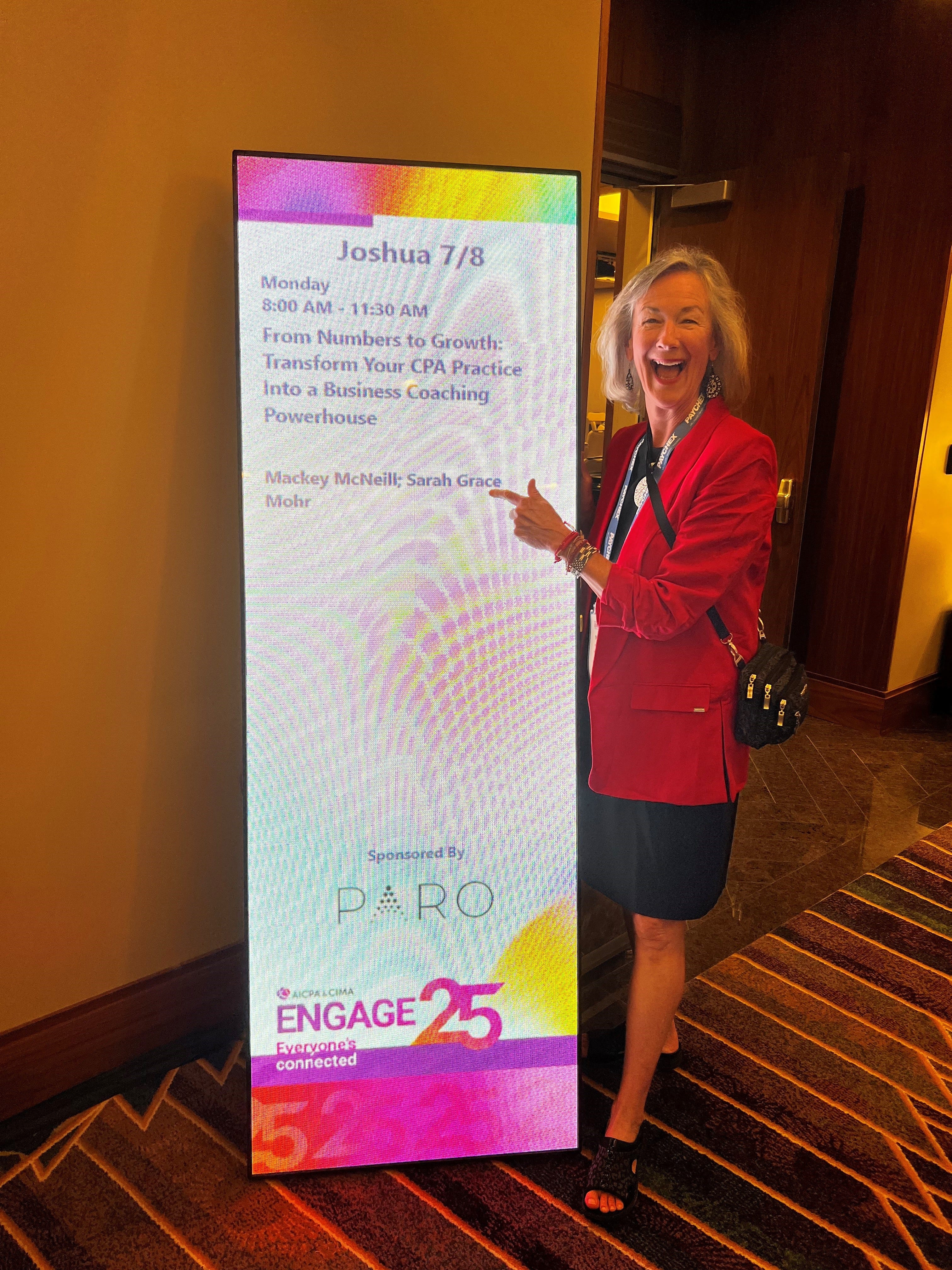
At Engage, I’ll be talking about the neuroscience of decision-making in an AI-accelerated world. But underneath all of it is one simple idea:
The CPA of the future is not a compliance processor or a number cruncher. The CPA of the future is a high-emotionally-intelligent fractional CFO, a trusted guide who helps business owners navigate their financial life with clarity, confidence, and courage.
That is not a role AI will fill. That is a role that only deepens in value as AI takes over everything else.
The Three Freedoms, time, mind, and money, that I talk about in The CFO Collaborative aren’t abstract goals. They are the lived experience of a CPA who has made the shift. Who has felt the fear of transformation, chosen possibility anyway, and discovered that the new ground is steadier than the old.
The profession is changing. The question is not whether you will be changed with it.
The question is whether you will choose the change, or wait for it to choose you.
I’ll be at Engage this summer. I hope to see you there. I hope to see you in my session. You can use this link and code POPUP26 at checkout for $200 off your ticket.
I’d love to know: where are you on this journey? Are you feeling the fear? Have you started moving toward the new ground?
Reply to this letter. I read every one.
And if you’re a CPA ready to explore what the shift to Fractional CFO looks like for you specifically, that’s exactly the work we do together at The CFO Collaborative.
-Mackey
—
I’m Mackey, founder of The CFO Collaborative. I help CPAs move from compliance to coaching, building practices and lives they love. If this resonated, I’d love to hear what it brought up for you. Hit reply.
Find me on LinkedIn or head to thecfocollaborative.com